

SOLUTIONS
Enhancing U.S. Generation Capability
Richard B. Russell Dam LCG
Cleaveland/Price is well known for its substation class switches, motor operators and controllers to integrate any manufacturer’s switch into a utility’s SCADA system. Not so well known is our involvement on the generation side. One example of Cleaveland/Price’s engineering capability was at the Richard B. Russell Dam on the Savannah River at the border of Georgia and South Carolina where we supplied custom designed switches for the hydroelectric power plant.
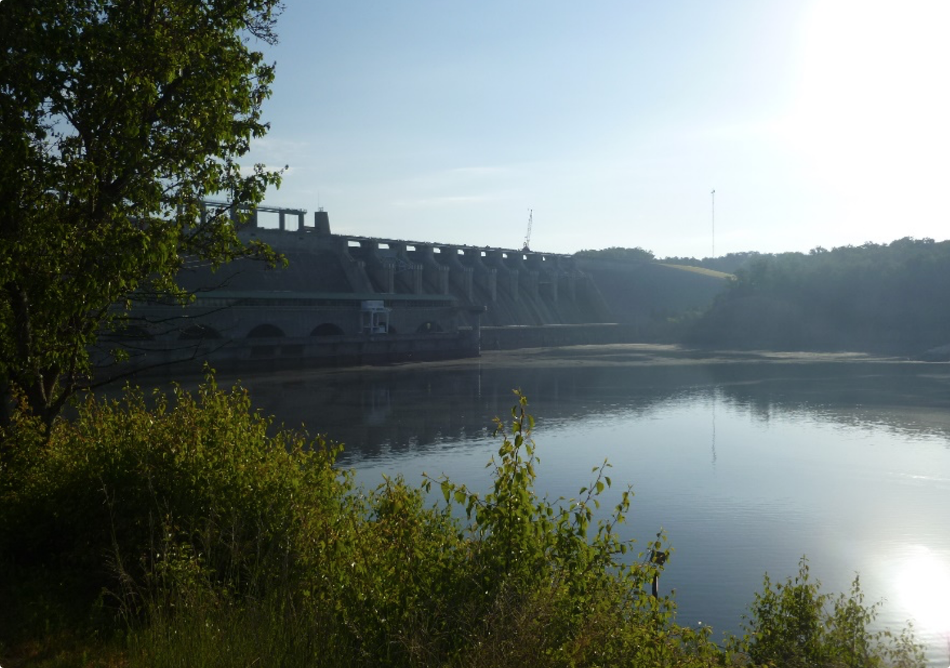
The Richard B. Russell dam is a concrete-gravity and embankment dam built between 1974 and 1985 by the U.S. Army Corps of Engineers for hydroelectricity, flood control, water supply and fish and wildlife management. The dam has an installed capacity of 600 MW (800,000 hp) and spans 1,904 feet across and 210 ft above the riverbed of the Savannah. The dam is managed by the Department of Energy’s Southeastern Power Administration(SEPA) and the hydroelectric power plant is known as a “peaking” plant meant to supply clean power during times of peak daily demand.
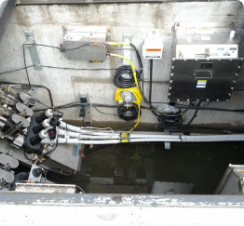
Cleaveland/Price worked with Atlantic City Electric to design and install 15kV, 5000A and 1200A gang operated isolated phase switches for U.S. Army Corps of Engineers. Isolated or segregated phase bus duct is typically used to carry high current between a generator and step up transformer at power generation plants. The bus conductors are enclosed in separate, grounded housings to decrease the chance of a fault between the generator and transformer. In some cases cooled air is blown through the ducts to keep the bus temperature rise within required limits. Each isophase switch project is unique and the switch is customized to meet the bus and site requirements. Cleaveland/Price had supplied isolated phase bus duct switches for other similar hydroelectric power plant projects and applied our many years of design knowledge in this area here.
Prior to designing the switches, engineers from Cleaveland/Price visited the site and took measurements to verify existing dimensional information and worked closely with the bus duct supplier to ensure smooth installation of the switches in the bus duct runs. The 15kV, 5000A switches were located in large concrete bays outside the dam and were installed in a vertical orientation mounted to a steel structure. The switches were enclosed by custom designed and fabricated aluminum enclosures with round duct connection collars at each end. The customer did not already have switches installed in the proposed locations so a section of each phase of the aluminum bus ducts was cut out to accept the enclosures. The round duct connection collars were then welded in place to the existing bus duct. Each enclosure was designed to accept a viewing window and an IR window to allow the customer to safely scan the switches from outside the enclosure.
The switches for this application were type V2-HC copper vertical break switches with silver plated terminal pads and tubular aluminum bases. The proven V2-HC switches were chosen for this application because of the high continuous current and short circuit current requirements. Each aluminum enclosure was equipped with a top mounted light to allow clear visibility of the switch for maintenance inspections. Once the switches were mounted to the steel support structures the geared handcrank operator and vertical pipe were connected to the 90° miter gearbox to allow the switch to be operated from the ground. A key interlock was installed on the vertical pipe for safety to ensure proper equipment switching sequence.
Ron Miller of Atlantic City electric gave the following feedback on the switches and installation. “The only comment that I have, it is by far the best disconnect that I had to install. There were very few adjustments that had to be made in the field. The CORPS were happy with them.”
The only comment that I have, it is by far the best disconnect that I had to install. There were very few adjustments that had to be made in the field. The CORPS were happy with them.
— Ron Miller of Atlantic City Electric